

Baptiste Debombourg
Exhibitions
Works
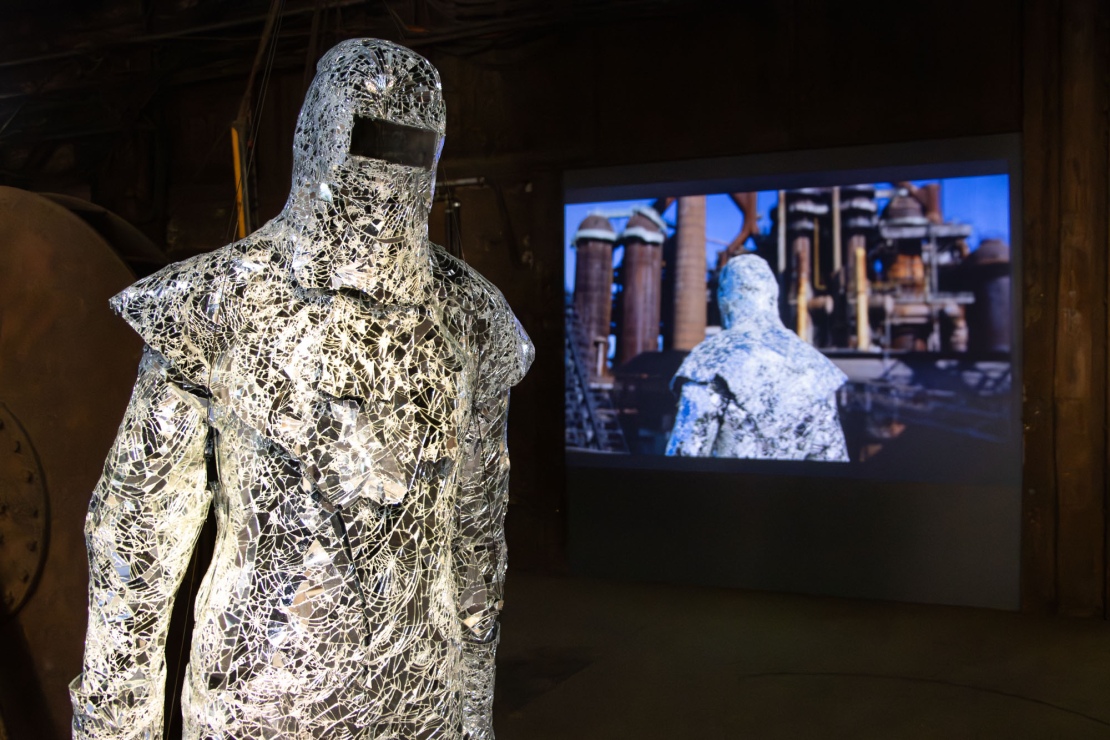
Solar echo
Date
2026, in situ
Material
Broken mirror, leather, textiles, silicone, cyanolite and neoprene; video of the figure walking
Description
With Solar Echo, the Parisian artist Baptiste Debombourg presents a site-specific work that straddles the boundaries between sculpture and performance, poetically re-activating the space of the Völklinger Hütte. The starting point is a sculpture composed of broken mirrors. The refraction and scattering of natural light create a fleeting interplay of reflections, which are vividly captured in the film on display. The work is intended as a tribute to the workers of the former ironworks. Debombourg’s artistic practice is characterised by a paradoxical impulse: he constructs from fragments, from destruction and remnants. The starting point for his works is often an act of dismantling everyday objects such as furniture or glass, which he then transforms into new, often monumental yet fragile structures. He is less interested in the violence of the moment than in what emerges afterwards: processes of repair, reinterpretation and resilience.
Streetectures #9, #10, #11, #13, #14, #15
Composition after anonymous artist, spray paint, acrylic, and Posca markers on an architectural plan
2026
Streetectures #12
Composition after Backo, Sano and an anonymous artist, spray paint, acrylic, and Posca markers on an architectural plan
2026
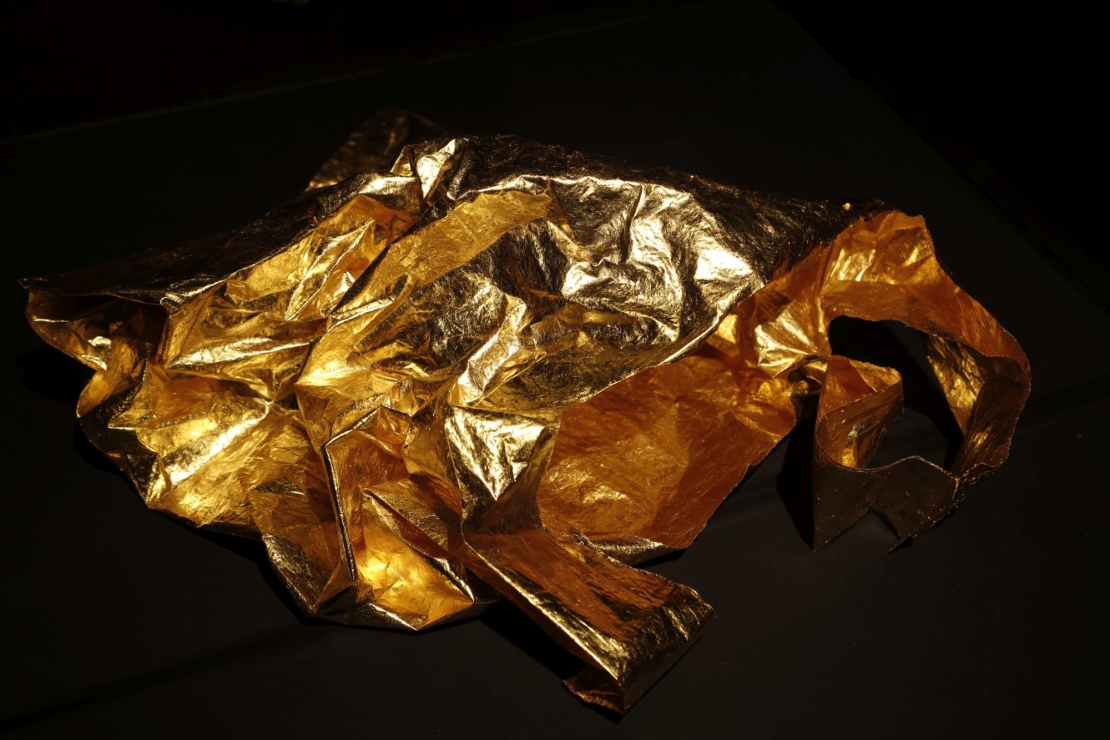
Marx
Date
2017
Owner
Courtesy of the Artists – Adagp Paris
Description
A mass-produced plastic bag covered with 24-carat gold leaf and bearing the title Marx – without doubt, Baptiste Debombourg’s piece for the Urban Art Biennale 2024 has a sarcastic, provocative edge. Yet for the Parisian artist, Marx – which he created together with David Marin – is first and foremost a satire on the exaggerations and exaltations of capitalism, which turns cheap, mass-produced goods into extremely desirable cult objects. Made from the “black gold” of crude oil, plastic is convenient for producers and consumers alike. And, despite being harmful to the environment, it continues to play a key role in today’s consumer society. Yet aren’t such a lifestyle and economy simply a luxury with destructive consequences? And will the time come when plastic becomes so rare that it will be prized like a precious relic in the showcase of a museum? Presenting Marx within the World Heritage Site Völklinger Hütte also unleashes a long chain of associations. After all, didn’t the Röchling family of ironworkers once turn to plastics as a new field of business following their retreat from coal and steel? And haven’t, in the past, major cultural and historical exhibitions at the World Heritage Site thematised the fascination with gold and the devotional significance attached to gold objects – by, for example, the Ancient Egyptians, the Celts and the Incas? The work is typical of Debombourg in as much as his art, which also includes grandiose, immersive works, is often based on everyday materials and objects.
Daniel Bauer