

Stephane Moscato
Exhibitions
Works
Cartographie sensible
Date
2026, situ
Material
Spray paint on the floor
Description
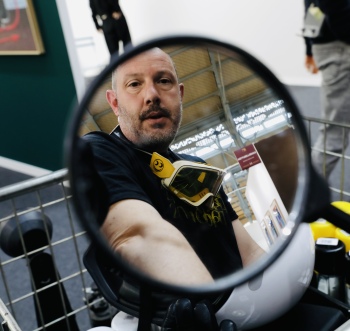
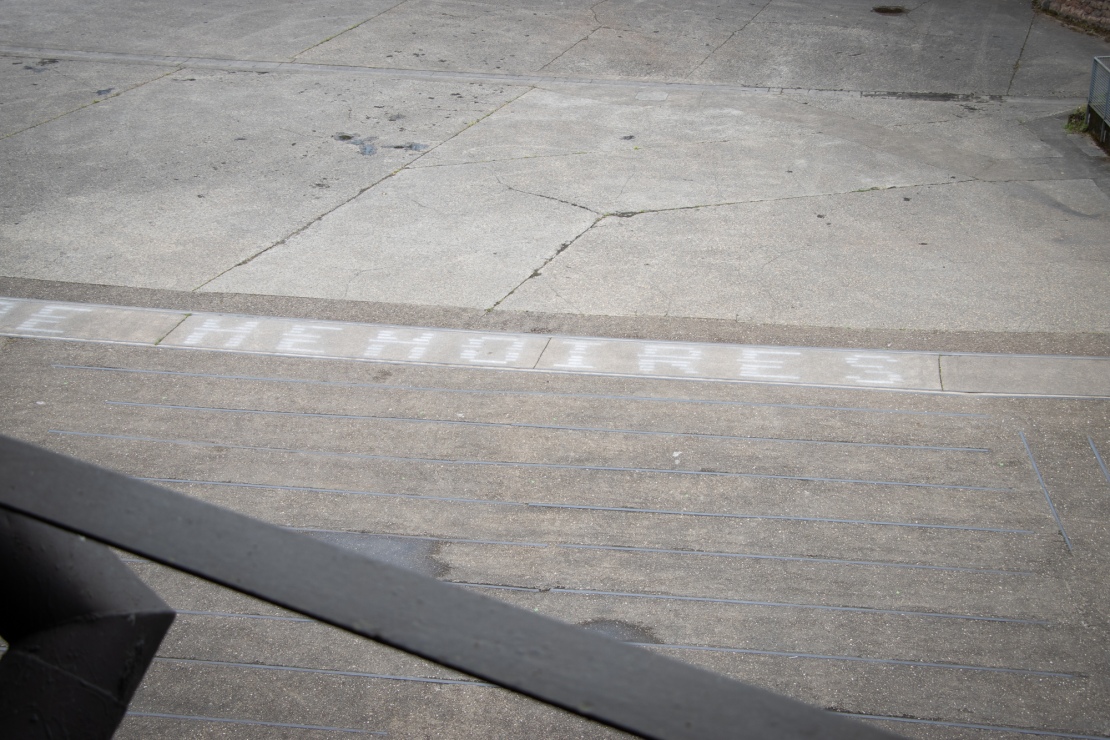
The Marseille-based artist Stéphane Moscato has long been working at the intersection of writing, machinery and the built environment. For the 2026 Urban Art Biennale, he is presenting an installation realised using a tricycle, which he has repurposed as a writing instrument. A group of spray cans is mounted on the front of the vehicle, which are triggered in time with his movements. As Moscato pedals, words and fragments of sentences are written directly onto the road surface. Speed, trajectory and the geometry of the surface determine the shape of each individual letter. In this instance, the writing adapts to one of the old tram tracks in the district and follows it for a distance of 500 metres. The result can be read in two ways: at street level, it appears as a fragmentary, almost calligraphic trail; from a height – for example, from a footbridge, a window or a vantage point – it reveals itself as a cartographic drawing and a poetic echo. The work is ephemeral by its very nature; the lines disappear due to traffic and the weather. After more than a month, the spray-painted words have vanished, preserved in photographs and videos.
Les mains d'or
Date
2022, in situ
Dimensions
450 x 425 cm
Material
Acrylic, spray paint, wood
Description
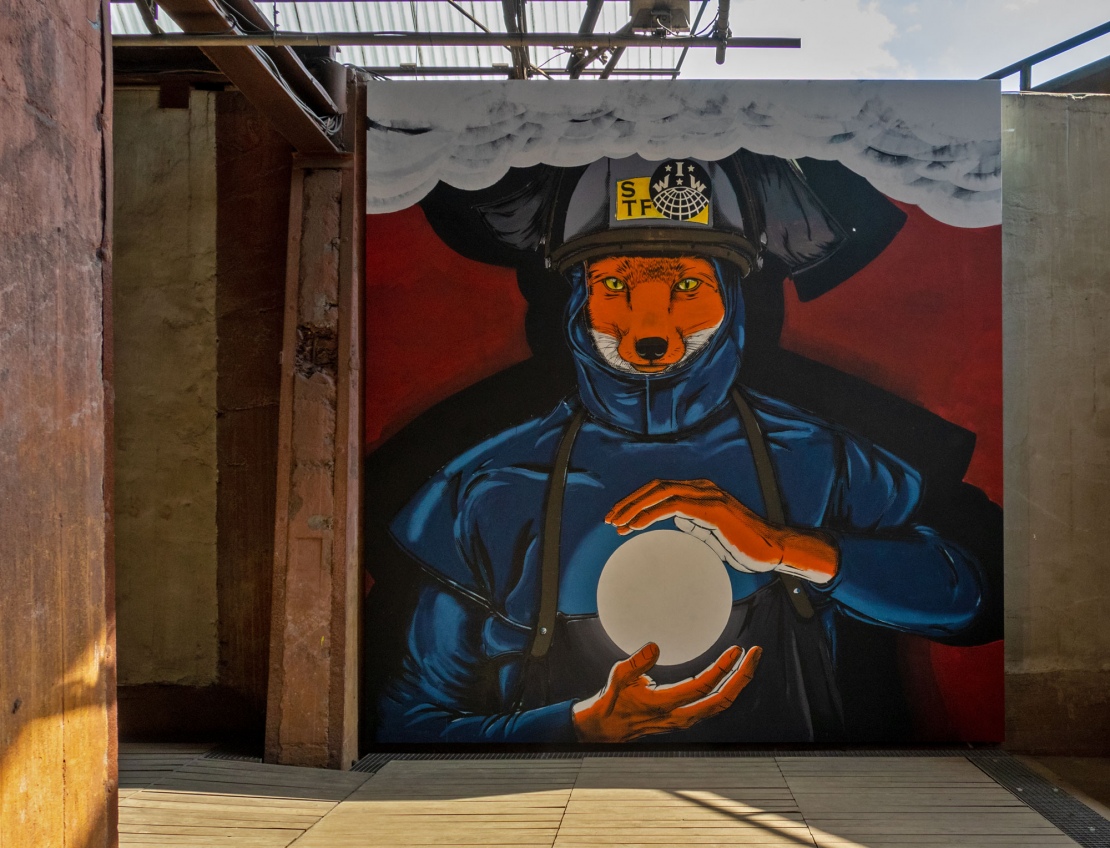
The works of Stéphane Moscato generally involve the interplay of pochoir, or stencil graffiti, and décollage, the finding, tearing, and recombining of poster assemblages. His topics lie in the Anthropocene, contemporary society, and civilization with its ambivalent relationship to the animalistic. The protagonists depicted frequently boast animal heads, the import of which oscillates between masking and unmasking. Les mains d'or, located in the Burden Shed of the Völklingen Ironworks, is a painting on a provisional wall—a panel painting.
The allegorical figure, a fox, is forming a magically glowing sphere from the searing iron ore. The figure is a symbolic representation of the Völklingen metallurgical workers, as well as for the anthro-historical influence of the principles of metallurgy. Without direct contact with the hands, the material hovers within the energetic center. Moscato is "fascinated by the inconceivable forces" which, as in the myth of Hephaestus, the Greek god of fire and smithery, are used "to create matter."